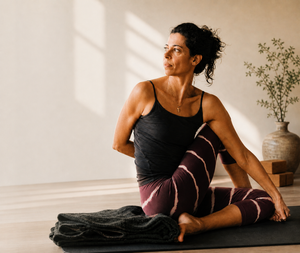
Understanding Stretching and Mobility in Yoga
I find it funny when people say yoga is just about stretches or getting more flexible. They mean bending far enough to touch their toes in class, and I laugh like that's the whole point. What's missing in that view is mobility. MOBILITY!
Stretch vs. Mobility
Stretching and mobility are related but distinct concepts that both affect how your body moves. Understanding the difference helps you choose the right practice for your goals—whether that’s increased range of motion, better movement quality, pain reduction, or athletic performance. Yoga can offer both, when practiced with awareness, stability and control. Let’s understand stretching and mobility…
What Stretching Is
Purpose: Increase flexibility by lengthening muscle-tendon units and connective tissue.
Typical methods: Static stretching (holding a position for 20–90 seconds), dynamic stretching (controlled movement through a range), and PNF (contract–relax techniques).
What it changes: Tissue extensibility and neural tolerance to length. Static stretching can reduce passive stiffness and increase how far a joint can be moved when relaxed.
Use cases: Cooling down, improving flexibility for certain activities (e.g., splits, hamstring length), temporarily increasing range of motion.
Limitations: Stretching alone does not guarantee improved control or strength throughout the new range. Overdoing static stretching before strength or power activities can reduce force production.
What Mobility Is
Purpose: Improve the ability to control and use joint range of motion functionally — strength, stability, coordination, and quality of movement across a joint.
Typical methods: Active movements through full range (controlled joint-loaded movements, loaded/weight-bearing exercises, eccentric and isometric work, movement pattern drills), combined with targeted soft-tissue work and neuromuscular training.
What it changes: Neuromuscular control, joint mechanics, and the capacity to produce force through ranges of motion. Mobility addresses movement quality, not just passive range.
Use cases: Enhancing movement for daily activities and sports, reducing injury risk by improving joint control, translating flexibility into usable strength and coordination.
Practical Differences
Passive vs. active: Stretching often emphasizes passive lengthening; mobility emphasizes active control and strength through the range.
Goal: Stretching → more passive ROM. Mobility → usable ROM with stability and control.
Assessment: A stretch shows how far a joint can be moved passively. Mobility is tested by seeing if you can move and control that range under load or in functional patterns (e.g., deep squat with upright torso, overhead reach without compensation).
In summary, stretching increases passive range; mobility builds the strength, control, and coordination to use that range functionally.
Now, let’s move to yoga, and see how it uses stretch and mobility in posture practice.
Yoga doesn’t really fit the “exercise” category. Traditionally, and textually, yoga is described as a state of being achieved through certain practices, and asana (postures) is one of them. Focusing on the physical portion of yoga, which is what we know and practice the most, we must understand how to use yoga postures in a way that it is beyond simple flexibility work, and have a more mobility-focused approach, creating a richer yoga practice. It is important to remember that, Yoga is a holistic system combining breath, mindful awareness, alignment, movement patterns (asanas), and often philosophy. It includes elements of stretching and mobility but situates them within breath-led, conscious practice.
How Yoga Uses Stretching:
Many yoga poses include sustained muscle lengthening: forward folds, lunges, shoulder-openers. These create passive and active flexibility improvements.
Breath and relaxation in yoga can reduce guarding and allow deeper, safer release than isolated stretching done without internal focus.
Yoga’s sequencing often alternates opposing stretches (e.g., opening and strengthening) to balance tissues and reduce overstretching risk.
How Yoga Cultivates Mobility:
Moving between poses (vinyasa, flow) trains joints through coordinated ranges under load and control, improving usable mobility.
Preparatory and transition movements—rolling up from spine flexion to extension, threaded through variations, hip circles in standing—build joint control and proprioception.
Many yoga postures require not just length but integrated strength: standing balances, arm balances, and transitions demand motor control through the joints, which is the essence of mobility.
Practical Ways to Integrate Mobility Principles Into Yoga
Add slow, controlled movement through the joint’s full range before holding a pose (e.g., hip circles before lunges; scapular mobility before downward dog).
Emphasize eccentric and concentric muscle engagement in poses (e.g., control on the way into and out of a forward fold) to build usable range.
Use breath to coordinate movement and enhance motor control: inhale to create space, exhale to stabilize into deeper range while maintaining core connection.
Sequence for balance: pair opens with strength (e.g., deep lunge followed by chair pose) and alternate spinal flexion and extension.
Progress slowly and mindfully; prioritize pain-free, controlled range rather than maximal passive stretch.
The benefits of understanding and integrating mobility into yoga practice include greater joint resilience and functional range of motion for everyday tasks and athletic activities, improved body awareness and safer expression of flexibility because breath and mindfulness reduce reactive tension, and increased capacity to access strength through fuller ranges, reducing compensatory movement patterns that can cause injury. For sustainable movement and performance, prioritize mobility work and use stretching selectively.
Yoga contains both stretching and mobility elements, but its distinctive contribution is the integration of breath, attention, and whole-body sequencing. Yoga asana (postures) can be a platform for cultivating both safe flexibility and functional mobility: use mindful, controlled movement and balanced sequencing to build strength through range, and supplement as needed with targeted mobility or strength work for specific joint needs.
Safe practice!
HariOm