Why Yoga Shouldn’t Feel Like Performance
When did yoga become something to achieve instead of something to experience?
Years ago, when I first began practicing yoga, many conversations revolved around spirituality — around meditation, awareness, and the possibility that practice could transform your life. However, what unfolded in the years that followed was something I didn’t expect.
In Western culture, with its emphasis on performance, productivity, and achievement, yoga became absorbed into the same framework. Somewhere along the way, this ancient science began shifting toward something increasingly superficial: aesthetic, performative, and obsessively physical.
The question is — at what cost?
Yoga Was Never Just About the Poses
I was fortunate to learn from deeply knowledgeable teachers early in my yoga journey. Yes, they taught postures, and yes, my practice evolved from Anusara into Ashtanga Yoga — a demanding and deeply physical discipline. But what stayed with me most wasn’t the pursuit of perfection in shape.
My teachers emphasized yoga philosophy, mythology, self-study, and understanding the body and mind through practice. There was a reverence for tradition. A commitment to learning not just from teachers, but from the yogic texts themselves — not to stay trapped in dogma, but to build a strong foundation for an authentic yoga practice rooted in depth.
Because yoga was never meant to stop at flexibility.
Nowadays, yoga is often treated as exercise — and not just exercise, but hardcore exercise. Push harder. Stretch deeper. Sweat more. Become more flexible. Perform.
And listen — there is immense value in asana (the physical postures). Don’t mistake me. The body matters. The poses matter. But yoga is so much more than standing on your head or achieving the perfect handstand.
Yoga asks deeper questions:
How do you treat others?
How do you treat yourself?
Can you regulate your nervous system?
Can you sit with discomfort?
Can you pay attention?
The postures are only one doorway into the practice.
Awareness. Breath. Ethics. Presence. The stilling of the fluctuations of the mind — that is yoga.
The ancient aim of yoga was never simply performance. It was connection.
The Problem With Performance-Based Yoga Culture
When yoga becomes performance, we forget something essential:
Practice is organic.
It changes.
It evolves.
And some days, your practice may simply be breathing.
We cannot perform physically at 100% every time we step onto the mat. Nor should we. A sustainable, grounded yoga practice makes room for the full spectrum of being human.
This obsession with physical optimization makes me think about yoga burnout — something I see often.
I remember staying in India during a period of personal study. One morning, while hiking uphill toward breakfast, I ran into a kind young man I had spoken with before. He looked at me and said:
“You look really tired. What happened?”
I told him I had just returned from yoga class.
He paused and said something I’ve never forgotten:
“If your yoga practice is making you tired, it’s not good yoga.”
That stayed with me.
Because it raises an important question:
Is your yoga practice actually improving your energy?
Does it leave you feeling more alive?
Does it support your nervous system?
Does it cultivate steadiness in the mind?
Or does it leave you depleted, anxious, comparing yourself, or chasing an impossible standard?
The performative mindset tells us we must constantly become “better.” More flexible. More advanced. More impressive.
But authentic yoga asks something different.
It asks us to listen.
To move mindfully.
To understand the body we live in.
To recognize that postures are not the whole of practice — only one tool among many.
Returning to Yoga as Practice, Not Performance
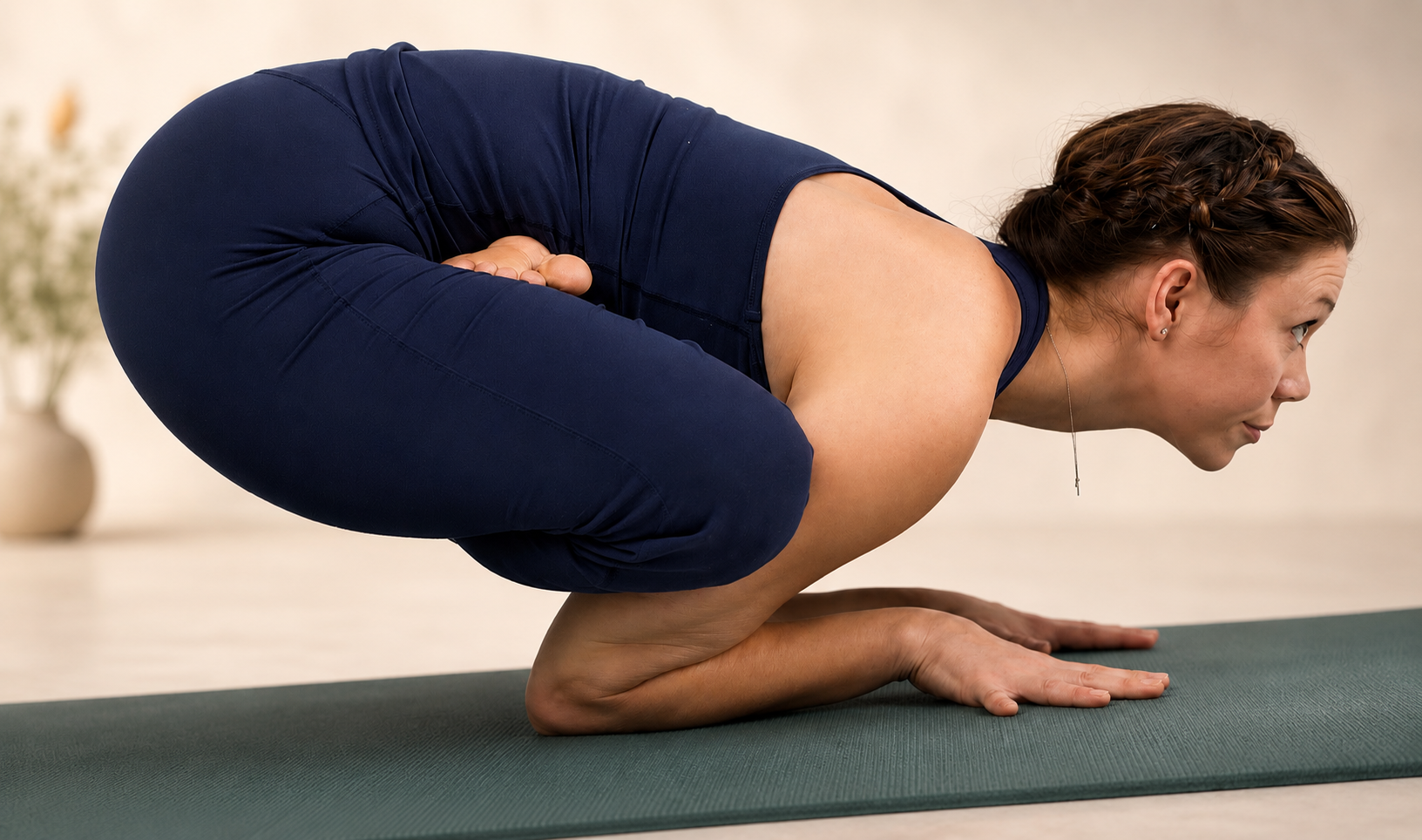
I love asana. Truly.
The physical practice, when paired with awareness, has given me strength, resilience, and a profound connection to my body.
For many of us, postures were the doorway into yoga. They were for me.
But if yoga ends at aesthetics — if it becomes about comparison, image, and chasing the body we think a yogi should have — we miss the point entirely.
Yoga was never meant to be something we perform.
It was meant to be something we inhabit.
A return to mindful living.
A moving meditation.
A relationship with ourselves that asks for honesty over achievement.
Perhaps the practice is not about becoming someone else.
Perhaps it’s about remembering who you already are.
Continue the Practice
If this resonates, perhaps what you’re seeking isn’t another class — but space to ask deeper questions.
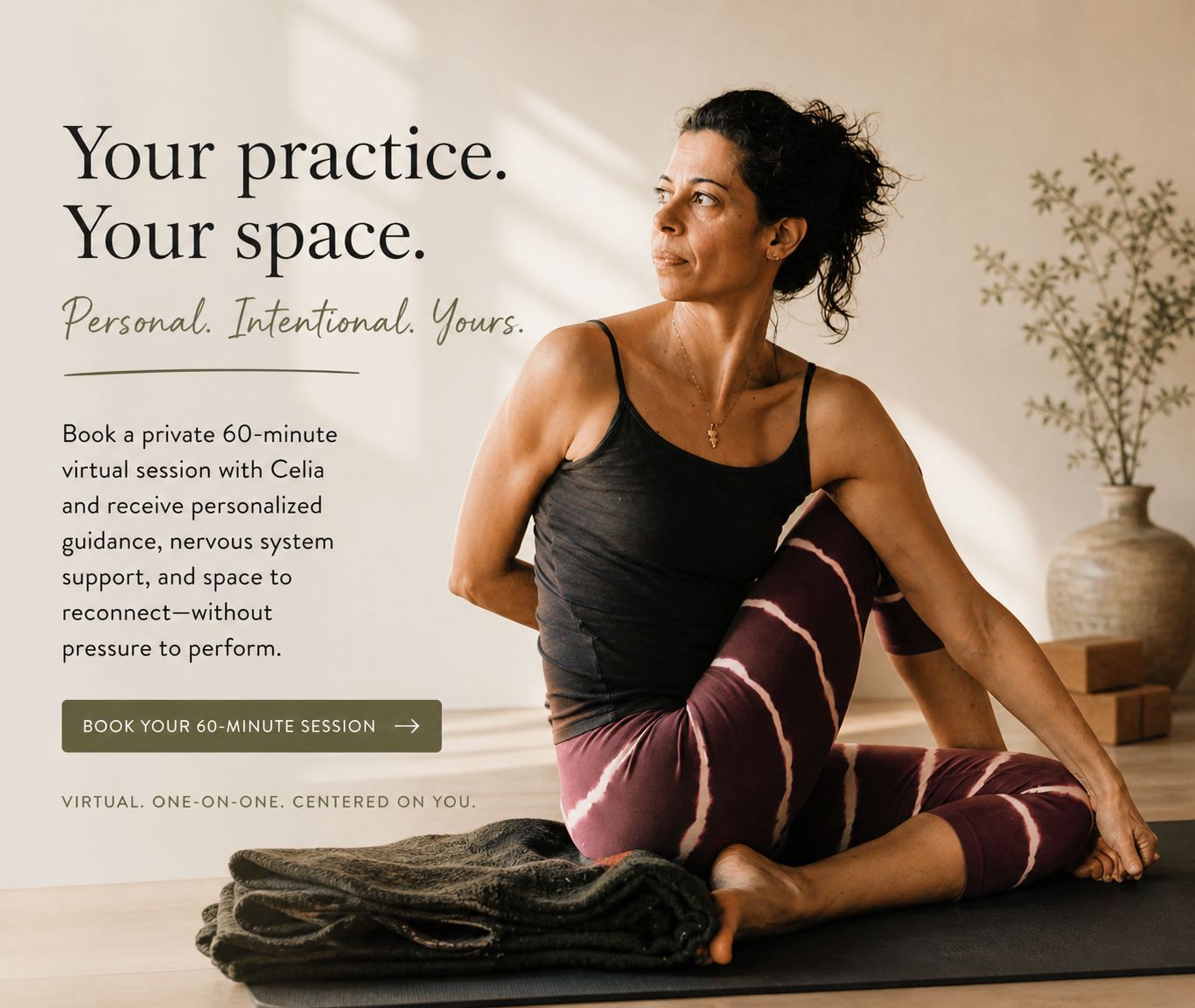
Celia offers one-on-one 60-minute virtual sessions for students looking to refine their practice, deepen their understanding of yoga, work through physical or energetic sticking points, or reconnect to movement in a more meaningful way.
Whether you're navigating injury, burnout, inconsistency, confusion in your practice, or simply craving more depth, these sessions are tailored to you.
A thoughtful space for curiosity, refinement, and returning to what practice can feel like.
Book a 60-minute virtual session with Celia →
Hari Om